
Posted by TJ Hopkins on Jun 10th 2026
12 Drought Resistant Trees to Grow in Colorado Now
Colorado’s dry climate, intense summer sun, and periodic drought conditions can make tree selection challenging. Fortunately, many trees thrive in Colorado’s semi-arid environment while providing shade, wildlife habitat, seasonal color, and long-term beauty. Choosing drought-resistant trees can reduce water usage, lower maintenance requirements, and help create a more sustainable landscape.
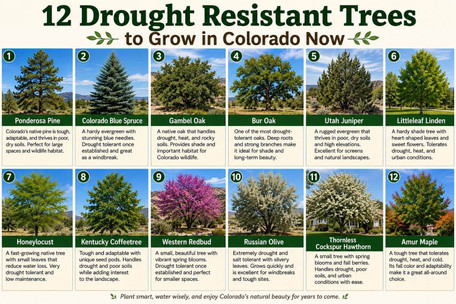
Here are 12 excellent drought-resistant trees that perform well across much of Colorado.
1. Ponderosa Pine (Pinus ponderosa)
The Ponderosa Pine is one of Colorado’s most iconic native trees. Known for its tall stature, orange-brown bark, and long needles, it thrives in poor, dry soils once established. This hardy evergreen provides year-round beauty and valuable wildlife habitat.
Why Grow It:
- Native to Colorado
- Excellent drought tolerance
- Long-lived and low maintenance
- Great for large properties
2. Colorado Blue Spruce (Picea pungens)
Colorado’s state tree is admired for its striking blue-gray needles and symmetrical shape. While young trees require regular watering, mature specimens become relatively drought tolerant and make excellent windbreaks.
Why Grow It:
- Stunning ornamental appearance
- Evergreen privacy and screening
- Cold hardy and adaptable
- Attractive year-round
3. Gambel Oak (Quercus gambelii)
A native oak species found throughout Colorado foothills, Gambel Oak handles drought, heat, and rocky soils with ease. Its dense growth provides shelter for birds and wildlife while offering brilliant fall color.
Why Grow It:
- Native and highly adaptable
- Excellent wildlife value
- Beautiful autumn foliage
- Handles poor soils well
4. Bur Oak (Quercus macrocarpa)
Bur Oak is one of the most drought-tolerant oak species available. Its deep root system helps it survive dry conditions while providing broad shade and impressive longevity.
Why Grow It:
- Exceptional drought resistance
- Strong, durable structure
- Large shade canopy
- Long lifespan
5. Utah Juniper (Juniperus osteosperma)
This rugged evergreen is naturally adapted to dry western landscapes. Utah Juniper thrives in rocky soils, high elevations, and areas with limited rainfall.
Why Grow It:
- Extremely water-efficient
- Evergreen screening tree
- Excellent for natural landscapes
- Thrives in challenging conditions
6. Littleleaf Linden (Tilia cordata)
Littleleaf Linden is a versatile shade tree that tolerates heat, drought, and urban environments. Its fragrant summer flowers attract pollinators, while its dense canopy provides cooling shade.
Why Grow It:
- Excellent shade tree
- Attractive heart-shaped leaves
- Fragrant flowers
- Adaptable to urban settings
7. Honeylocust (Gleditsia triacanthos var. inermis)
Honeylocust is prized for its small leaflets that create filtered shade and reduce water loss. It grows quickly and adapts well to drought and difficult growing conditions.
Why Grow It:
- Fast-growing
- Low maintenance
- Drought tolerant
- Light, airy canopy
8. Kentucky Coffeetree (Gymnocladus dioicus)
This unique tree features large compound leaves and an open branching structure. Once established, it tolerates drought, heat, and poor soils remarkably well.
Why Grow It:
- Tough and adaptable
- Unique appearance
- Handles urban conditions
- Minimal pest problems
9. Western Redbud (Cercis occidentalis)
Western Redbud produces vibrant pink-purple flowers in spring that brighten any landscape. This small ornamental tree thrives in dry conditions and is ideal for smaller yards.
Why Grow It:
- Spectacular spring blooms
- Compact size
- Drought tolerant
- Great accent tree
10. Russian Olive (Elaeagnus angustifolia)
Russian Olive has long been valued for its ability to grow in extremely dry, poor soils. Its silvery foliage provides unique visual appeal and excellent wind resistance.
Why Grow It:
- Extremely drought tolerant
- Fast-growing
- Wind resistant
- Unique silver foliage
Note: Russian Olive is considered invasive in some regions. Check local regulations before planting.
11. Thornless Cockspur Hawthorn (Crataegus crus-galli var. inermis)
This small ornamental tree offers attractive spring flowers, berries for wildlife, and excellent drought tolerance. Its compact size makes it suitable for residential landscapes.
Why Grow It:
- Spring blooms
- Wildlife-friendly berries
- Compact growth habit
- Handles urban conditions
12. Amur Maple (Acer ginnala)
Amur Maple is a tough, adaptable tree that performs well in Colorado landscapes. It tolerates drought, heat, and cold while delivering outstanding red-orange fall color.
Why Grow It:
- Brilliant fall foliage
- Adaptable to many soils
- Moderate drought tolerance
- Ideal for smaller yards
Tips for Establishing Drought-Resistant Trees
Even drought-tolerant trees need consistent moisture during their first few years. To improve establishment success:
- Water deeply but infrequently.
- Apply 2–4 inches of mulch around the root zone.
- Avoid over-fertilizing.
- Plant during spring or fall when temperatures are moderate.
- Select species suited to your elevation and USDA hardiness zone.
Final Thoughts
Planting drought-resistant trees is one of the best ways to create a resilient Colorado landscape. Whether you prefer towering evergreens like Ponderosa Pine and Colorado Blue Spruce, shade trees such as Bur Oak and Littleleaf Linden, or ornamental favorites like Western Redbud and Amur Maple, these trees can thrive with less water while adding beauty and value to your property for decades to come.