
Posted by TJ Hopkins on Jul 9th 2026
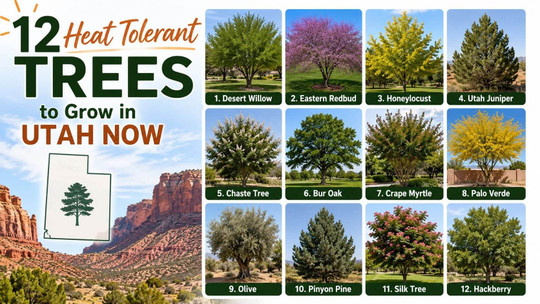
12 Heat-Tolerant Trees to Grow in Utah Now
Utah's climate can be challenging for homeowners and gardeners. Hot, dry summers, alkaline soils, limited rainfall, and varying elevations mean that not every tree will thrive. Fortunately, many beautiful trees are well-adapted to Utah's conditions, providing shade, colorful blooms, wildlife habitat, and year-round beauty while requiring less water than many traditional landscape trees.
Here are 12 excellent heat-tolerant trees that grow well across much of Utah.
1. Desert Willow (Chilopsis linearis)
Despite its name, Desert Willow isn't a true willow. It's a drought-loving ornamental tree known for its trumpet-shaped flowers that bloom throughout summer.
Why you'll love it:
- Thrives in intense heat
- Beautiful pink to lavender flowers
- Attracts hummingbirds and bees
- Very low water requirements
Growing Conditions
- USDA Zones: 7–10
- Height: 20–30 feet
- Full sun
- Excellent drainage required
2. Eastern Redbud (Cercis canadensis)
Eastern Redbud brings spectacular early spring color with masses of pink blossoms before the leaves emerge.
Highlights
- One of the first trees to bloom each spring
- Heart-shaped leaves
- Moderate drought tolerance once established
- Excellent ornamental specimen
Growing Conditions
- USDA Zones: 4–9
- Height: 20–30 feet
- Full sun to partial shade
3. Honeylocust (Gleditsia triacanthos var. inermis)
Honeylocust is an outstanding shade tree thanks to its open canopy that provides filtered sunlight, allowing grass and garden plants to grow underneath.
Benefits
- Heat and drought tolerant
- Fast-growing
- Attractive yellow fall color
- Low maintenance
Growing Conditions
- USDA Zones: 4–9
- Height: 40–70 feet
- Full sun
4. Utah Juniper (Juniperus osteosperma)
Native to Utah, this rugged evergreen is perfectly adapted to dry climates and rocky soils.
Why plant it?
- Extremely drought tolerant
- Evergreen year-round
- Excellent for wildlife
- Handles poor soils
Growing Conditions
- USDA Zones: 5–9
- Height: 15–30 feet
- Full sun
5. Chaste Tree (Vitex agnus-castus)
Often grown as a large shrub or small tree, Chaste Tree produces fragrant spikes of lavender flowers during the hottest months of the year.
Features
- Long-lasting summer blooms
- Attracts butterflies and pollinators
- Excellent drought resistance
- Fast-growing
Growing Conditions
- USDA Zones: 6–9
- Height: 10–20 feet
- Full sun
6. Bur Oak (Quercus macrocarpa)
Bur Oak is one of the toughest oak species available. It tolerates heat, drought, wind, and a wide variety of soil conditions.
Advantages
- Large shade tree
- Long-lived
- Strong branching structure
- Excellent wildlife tree
Growing Conditions
- USDA Zones: 3–8
- Height: 50–80 feet
- Full sun
7. Crape Myrtle (Lagerstroemia indica)
Crape Myrtle provides months of colorful flowers while thriving in hot summer weather.
Popular for
- Pink, red, purple, or white blooms
- Attractive peeling bark
- Excellent fall color
- Low water needs
Growing Conditions
- USDA Zones: 6–10
- Height: 10–25 feet
- Full sun
8. Palo Verde (Parkinsonia florida)
Known for its striking green bark and bright yellow spring flowers, Palo Verde is one of the best trees for extremely dry landscapes.
Why choose it?
- Outstanding drought tolerance
- Brilliant yellow blooms
- Unique appearance
- Requires minimal irrigation
Growing Conditions
- USDA Zones: 8–11
- Height: 20–30 feet
- Full sun
9. Olive (Olea europaea)
Fruitless olive varieties are increasingly popular for Utah landscapes due to their drought resistance and attractive silvery foliage.
Benefits
- Evergreen beauty
- Very heat tolerant
- Long lifespan
- Low maintenance
Growing Conditions
- USDA Zones: 8–10
- Height: 20–30 feet
- Full sun
10. Pinyon Pine (Pinus edulis)
Native to the Southwest, Pinyon Pine is perfectly suited for Utah's dry climate.
Features
- Evergreen
- Slow-growing
- Highly drought tolerant
- Produces edible pine nuts
Growing Conditions
- USDA Zones: 5–8
- Height: 15–35 feet
- Full sun
11. Silk Tree (Albizia julibrissin)
Also called Mimosa Tree, Silk Tree produces fluffy pink blooms throughout summer and thrives in hot, sunny locations.
Highlights
- Tropical appearance
- Fast growth
- Fragrant flowers
- Pollinator favorite
Growing Conditions
- USDA Zones: 6–9
- Height: 20–40 feet
- Full sun
12. Hackberry (Celtis occidentalis)
Hackberry is one of the toughest shade trees available, tolerating drought, wind, pollution, and poor soils with ease.
Why it's a great choice
- Excellent shade tree
- Native adaptability
- Wildlife-friendly berries
- Very durable
Growing Conditions
- USDA Zones: 3–9
- Height: 40–60 feet
- Full sun
Tips for Growing Trees Successfully in Utah
Even drought-tolerant trees benefit from proper planting and care during their first few years.
- Plant during spring or fall whenever possible.
- Water deeply but infrequently to encourage deep root systems.
- Apply 2–4 inches of mulch around the base to conserve moisture.
- Avoid planting too deeply—keep the root flare at soil level.
- Choose species suited to your local elevation and USDA hardiness zone.
- Once established, reduce irrigation to improve drought tolerance.
Final Thoughts
Utah's hot summers don't have to limit your landscaping options. Whether you're looking for colorful flowering trees like Eastern Redbud and Crape Myrtle, rugged evergreens like Utah Juniper and Pinyon Pine, or large shade trees such as Bur Oak, Honeylocust, and Hackberry, these heat-tolerant selections can provide beauty, shade, and resilience for years to come.
By selecting trees adapted to Utah's climate and giving them proper care during establishment, you'll enjoy a healthier, lower-maintenance landscape that's ready to handle the summer heat.