
Posted by TJ Hopkins on Jul 2nd 2026
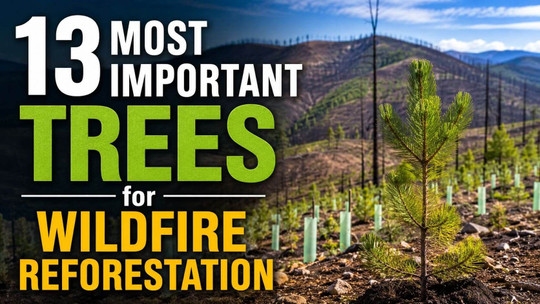
13 Most Important Trees for Wildfire Reforestation
Wildfires are a natural part of many forest ecosystems, but increasingly severe fire seasons are leaving behind landscapes that struggle to recover on their own. Reforestation plays a critical role in restoring wildlife habitat, preventing soil erosion, improving water quality, and helping forests become more resilient to future fires and climate change.
Choosing the right tree species is one of the most important decisions in any wildfire restoration project. Native species that are adapted to local climates and fire conditions often establish faster, support native wildlife, and create healthier forests for generations to come.
Here are 13 of the most important trees commonly used in wildfire reforestation efforts across North America.
1. Douglas Fir (Pseudotsuga menziesii)
Douglas Fir is one of the most widely planted trees after western wildfires. It grows quickly, develops strong root systems, and provides excellent wildlife habitat.
Benefits
- Fast-growing
- Excellent timber species
- Supports birds and mammals
- Long lifespan
Best Growing Zones
USDA Zones 4–6
2. Ponderosa Pine (Pinus ponderosa)
Ponderosa Pine evolved alongside natural fire cycles and is one of the most fire-adapted trees in western forests. Mature trees develop thick bark that helps protect them from low-intensity fires.
Benefits
- Highly drought tolerant
- Fire-adapted
- Deep root system
- Excellent wildlife habitat
Best Growing Zones
USDA Zones 3–7
3. Lodgepole Pine (Pinus contorta)
Lodgepole Pine is famous for its serotinous cones, which often release seeds after exposure to wildfire heat, making it an ideal pioneer species.
Benefits
- Naturally regenerates after fire
- Rapid early growth
- Stabilizes burned landscapes
Best Growing Zones
USDA Zones 4–8
4. Western Larch (Larix occidentalis)
Western Larch is one of the few deciduous conifers in North America. Its thick bark and high canopy make mature trees relatively resistant to fire.
Benefits
- Fire resistant when mature
- Fast growth
- Valuable wildlife habitat
- Beautiful golden fall color
5. White Fir (Abies concolor)
White Fir is commonly included in mixed-species restoration projects where moisture conditions allow.
Benefits
- Restores forest diversity
- Excellent shade tree
- Important wildlife cover
Best Growing Zones
USDA Zones 3–7
6. Sugar Pine (Pinus lambertiana)
The Sugar Pine is the world's tallest pine species and produces enormous cones that provide food for birds and mammals.
Benefits
- Excellent biodiversity value
- Large canopy
- Long-lived native species
7. Jeffrey Pine (Pinus jeffreyi)
Jeffrey Pine thrives in dry mountain environments where wildfire is common.
Benefits
- Excellent drought tolerance
- Fire-adapted
- Deep rooting system
- Long lifespan
8. Incense Cedar (Calocedrus decurrens)
Incense Cedar is increasingly planted in restoration projects because of its durability and moderate fire resistance.
Benefits
- Disease resistant
- Thick bark
- Attractive evergreen foliage
- Wildlife shelter
9. Giant Sequoia (Sequoiadendron giganteum)
Although naturally limited in range, Giant Sequoias have evolved with fire for thousands of years. Mature trees possess incredibly thick bark that protects them from wildfire.
Benefits
- Extremely fire resistant
- Exceptional longevity
- Valuable ecological species
10. Coast Redwood (Sequoia sempervirens)
Coast Redwoods can regenerate from both seeds and basal sprouts after wildfire, making them remarkably resilient.
Benefits
- Rapid regeneration
- Thick insulating bark
- Massive carbon storage
- Excellent erosion control
11. Quaking Aspen (Populus tremuloides)
Aspen often responds dramatically after wildfire by sending up thousands of new shoots from underground roots.
Benefits
- Rapid natural regeneration
- Improves biodiversity
- Excellent wildlife habitat
- Helps reduce future wildfire intensity
12. Black Cottonwood (Populus trichocarpa)
Black Cottonwood establishes quickly along streams and riparian areas damaged by wildfire.
Benefits
- Fast growth
- Prevents streambank erosion
- Supports pollinators and wildlife
13. Oregon White Oak (Quercus garryana)
Oak woodlands are naturally resilient to periodic fire and provide exceptional habitat for hundreds of wildlife species.
Benefits
- Fire tolerant
- Long lifespan
- Excellent wildlife food source
- Improves ecosystem diversity
Why Plant Multiple Tree Species?
Healthy forests are rarely made up of just one tree species. Reforestation projects that include a mixture of native trees are generally more resistant to insects, disease, drought, and future wildfires.
Mixed forests also:
- Increase biodiversity
- Improve wildlife habitat
- Enhance soil health
- Reduce the spread of pests
- Improve long-term forest resilience
Tips for Successful Wildfire Reforestation
- Choose tree species native to your region.
- Match each species to the site's elevation, soil, and moisture conditions.
- Protect young seedlings from deer, rodents, and harsh weather using tree shelters when appropriate.
- Control competing weeds and grasses during the first few growing seasons.
- Water young trees during prolonged droughts if possible.
- Plant a diverse mix of species instead of relying on a single tree type.
- Monitor survival rates and replace seedlings as needed during the first several years.
Final Thoughts
Wildfire reforestation is about much more than replacing lost trees—it's about rebuilding healthy, resilient ecosystems that can withstand future challenges. Species such as Douglas Fir, Ponderosa Pine, Lodgepole Pine, Western Larch, Giant Sequoia, and Quaking Aspen each play an important role in restoring burned landscapes.
By selecting native, site-appropriate trees and planting a diverse forest, landowners, conservation groups, and forestry professionals can help accelerate recovery, reduce erosion, improve wildlife habitat, and create forests that are better equipped to thrive for decades to come.