
Posted by TJ Hopkins on May 1st 2026
14 Best Plants to Attract Caterpillars
If you want a truly vibrant, living garden, attracting caterpillars is a must. While many gardeners see them as pests, caterpillars are actually essential—they’re the larval stage of butterflies and moths, which are critical pollinators. Even more importantly, caterpillars are a key food source for birds and other wildlife, making your garden part of a healthy ecosystem.
By planting the right host plants, you can support their entire life cycle and enjoy more butterflies, birds, and biodiversity right in your backyard.
Why Caterpillars Matter
Caterpillars are more than just leaf-eaters. They play a vital role in:
- Supporting butterfly and moth populations
- Feeding birds (especially baby birds)
- Maintaining balanced ecosystems
- Enhancing pollination through their adult forms
Planting for caterpillars means planting with purpose.
The 14 Best Plants to Attract Caterpillars
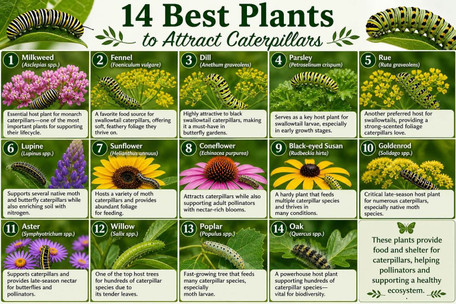
1. Milkweed (Asclepias spp.)
Milkweed is the essential host plant for monarch caterpillars. Without it, monarch butterflies cannot reproduce. It’s one of the most important plants you can grow for conservation.
2. Fennel (Foeniculum vulgare)
Fennel attracts swallowtail caterpillars, offering soft, feathery foliage they love to feed on.
3. Dill (Anethum graveolens)
A must-have for butterfly gardens, dill is highly attractive to black swallowtail caterpillars and grows easily in most conditions.
4. Parsley (Petroselinum crispum)
Parsley is another favorite host plant for swallowtail larvae, especially in early growth stages.
5. Rue (Ruta graveolens)
Rue provides strong-scented foliage that swallowtail caterpillars are naturally drawn to.
6. Lupine (Lupinus spp.)
Lupine supports a variety of native moth and butterfly caterpillars and improves soil by fixing nitrogen.
7. Sunflower (Helianthus annuus)
Sunflowers host numerous moth caterpillars and provide abundant foliage for feeding.
8. Coneflower (Echinacea purpurea)
Coneflowers attract caterpillars while also feeding adult pollinators with nectar-rich blooms.
9. Black-eyed Susan (Rudbeckia hirta)
A tough, adaptable plant that supports multiple caterpillar species and thrives in many environments.
10. Goldenrod (Solidago spp.)
Goldenrod is a critical late-season host plant, especially for native moth species preparing for overwintering.
11. Aster (Symphyotrichum spp.)
Asters support caterpillars and provide valuable late-season nectar for butterflies and pollinators.
12. Willow (Salix spp.)
Willow trees are among the top host plants, supporting hundreds of caterpillar species due to their tender leaves.
13. Poplar (Populus spp.)
Fast-growing and highly beneficial, poplars feed many caterpillar species, especially moth larvae.
14. Oak (Quercus spp.)
Oak trees are a powerhouse for biodiversity, supporting hundreds of caterpillar species and countless forms of wildlife.
Tips for Attracting More Caterpillars
- Plant in groups: Clusters make it easier for butterflies to find host plants
- Avoid pesticides: Even organic sprays can harm caterpillars
- Embrace some leaf damage: It’s a sign your garden is working
- Provide variety: Different species attract different caterpillars
- Include native plants: Native species support local ecosystems best
Final Thoughts
Creating a caterpillar-friendly garden means welcoming the full life cycle of butterflies and moths. While you may notice a few chewed leaves, the reward is a thriving, balanced ecosystem filled with life—from fluttering butterflies to singing birds.