
Posted by TJ Hopkins on Aug 9th 2026
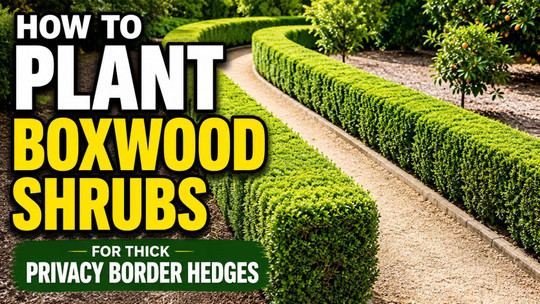
How to Plant Boxwood Shrubs for Thick Privacy Border Hedges
Boxwood shrubs are a classic choice for creating thick, attractive borders around a yard, garden, walkway, or property line. Their dense evergreen foliage provides year-round color, and regular pruning can turn a row of individual shrubs into a beautiful living privacy hedge.
The key to a successful boxwood hedge is choosing the right variety, spacing the plants correctly, and encouraging dense growth from the beginning. Here's how to plant boxwoods so they eventually form a healthy, thick border.
Why Choose Boxwoods for a Privacy Border?
Boxwoods (Buxus species) have been used in landscapes for centuries because they're adaptable and respond exceptionally well to pruning. Depending on the variety, they can be maintained as neat formal hedges or allowed to develop a softer, more natural appearance.
Boxwoods are especially useful because they offer:
- Evergreen foliage throughout the year
- Dense branching that responds well to pruning
- Excellent borders for walkways, patios, gardens, and property lines
- Numerous varieties with different mature heights
- Good tolerance of partial shade
- Long lifespans when planted in suitable conditions
One thing to remember is that most boxwoods aren't particularly fast-growing. Creating a dense hedge takes patience, but proper planting and care can help establish it much more quickly.
1. Choose the Right Boxwood Variety
Before planting, consider how tall and wide you want your finished hedge to become. Some boxwoods naturally remain compact, while others can eventually grow several feet tall.
Popular options include American boxwood, English boxwood, Japanese boxwood, Korean boxwood, Green Velvet, Green Mountain, and Wintergreen.
For a substantial privacy border, choose a variety whose natural mature height is reasonably close to your desired hedge height. This reduces the amount of constant pruning required later.
Also check the variety's USDA hardiness range before buying plants, particularly if you live in an area with very cold winters.
2. Select the Best Planting Location
Most boxwoods perform well in full sun to partial shade. In particularly hot climates, some protection from intense afternoon sunlight can be beneficial.
The planting site should have well-drained soil. Boxwoods generally don't tolerate constantly wet roots, so avoid low areas where water collects after heavy rain.
Good air circulation is also important. Although you want the plants close enough to eventually form a hedge, packing them together too tightly can encourage disease problems.
3. Decide How Far Apart to Plant Boxwoods
Spacing is one of the most important decisions when establishing a boxwood hedge.
The exact distance depends on the variety and the size of the shrubs you're planting. For many hedge-forming boxwoods, plants may be spaced approximately 2 to 3 feet apart, center to center. Smaller varieties may require closer spacing, while large-growing varieties need considerably more room.
Don't automatically plant shrubs extremely close together because you want an instant hedge. Overcrowding can create competition for water and nutrients while reducing airflow.
Always check the expected mature width of your particular variety before deciding on final spacing.
4. Mark a Straight Planting Line
If you're creating a formal border, use stakes and a string to establish a straight planting line.
Measure each planting position rather than estimating the spacing by eye. Consistent spacing will make the hedge look much more uniform as it matures.
For curved borders, a garden hose or rope can be laid on the ground to help visualize and adjust the shape before digging.
5. Dig the Planting Holes
Dig each hole approximately twice as wide as the shrub's root ball but no deeper than the root ball itself.
The wide planting hole makes it easier for new roots to spread into the surrounding soil.
Avoid planting boxwoods too deeply. Position the shrub so the top of the root ball is level with, or slightly above, the surrounding soil.
If you're planting many shrubs in a continuous hedge, digging a planting trench can sometimes make achieving consistent spacing and depth easier.
6. Examine the Roots Before Planting
Remove the boxwood carefully from its nursery container.
If roots are tightly circling the outside of the root ball, gently loosen them with your fingers. This encourages the roots to grow outward into the surrounding soil rather than continuing to circle.
Place the shrub in the hole and check its position from several directions before filling the hole.
7. Backfill Around the Shrub
Use the existing soil to fill around the root ball, gently firming it as you work to eliminate large air pockets.
Avoid heavily compacting the soil.
Once planted, water the entire root zone thoroughly. Deep watering helps settle the soil around the roots and reduces remaining air pockets.
8. Add a Layer of Mulch
Apply approximately 2 to 3 inches of organic mulch around your newly planted boxwoods.
Shredded bark, wood chips, or similar organic material can help conserve moisture, suppress weeds, and moderate soil temperatures.
Keep mulch a few inches away from the stems and trunk area. Don't pile mulch directly against the plant.
9. Keep New Boxwoods Consistently Watered
Newly planted boxwoods need dependable moisture while their root systems become established.
Water deeply rather than providing frequent shallow watering. You want moisture to penetrate throughout the root zone.
Check the soil regularly during the first growing season, especially during hot or dry weather. The soil should remain moderately moist without becoming constantly saturated.
Even established boxwoods can benefit from supplemental watering during extended droughts.
10. Prune to Encourage Thick Growth
Pruning is where individual boxwood shrubs gradually begin turning into a unified hedge.
Once plants are established, selective trimming encourages branching and denser foliage. Rather than immediately cutting the plants heavily, concentrate on developing healthy, bushy growth.
As the shrubs expand, neighboring plants will eventually begin growing together and filling the spaces between them.
For formal hedges, maintain a shape that is slightly wider at the bottom than at the top. This allows sunlight to reach the lower branches and helps prevent the base from becoming thin or bare.
How Long Does a Boxwood Privacy Hedge Take to Fill In?
There isn't one universal answer because growth rates vary considerably among boxwood varieties.
Plant size at installation, climate, soil quality, watering, sunlight, spacing, and pruning practices can all influence how quickly the hedge develops.
A hedge started with larger nursery shrubs will naturally look established sooner than one planted with small seedlings. However, even larger plants need time for their roots and branches to develop sufficiently to create a seamless border.
Should You Fertilize Boxwoods?
Don't assume that more fertilizer automatically means faster growth. Excessive fertilization can create weak growth and potentially damage plants.
If you're unsure about your soil's fertility or pH, a soil test is the best starting point. Fertilize only when the plants or soil conditions indicate that nutrients are needed.
A healthy root system, appropriate moisture, sufficient sunlight, and good soil drainage are usually more important than aggressive fertilization.
Common Boxwood Hedge Mistakes to Avoid
One of the biggest mistakes is planting boxwoods too deeply. Other common problems include overcrowding plants, allowing roots to remain waterlogged, piling mulch against stems, neglecting newly planted shrubs during drought, and repeatedly shearing only the outside surface of mature hedges.
Also watch your plants periodically for discolored foliage, dead branches, insects, or unusual leaf drop. Catching problems early makes them much easier to address.
Creating a Beautiful, Thick Boxwood Border
A dense boxwood hedge isn't created by planting shrubs as closely together as possible. The goal is to give each plant enough space to develop a strong root system and healthy branches while positioning neighboring plants close enough that their canopies eventually meet.
Choose a boxwood suited to your climate, prepare a well-drained planting area, maintain consistent moisture during establishment, and prune thoughtfully as the shrubs mature.
With time, those individual shrubs can grow together into a thick evergreen border that provides structure, privacy, and year-round beauty throughout your landscape.