
Posted by TJ Hopkins on Jul 17th 2026
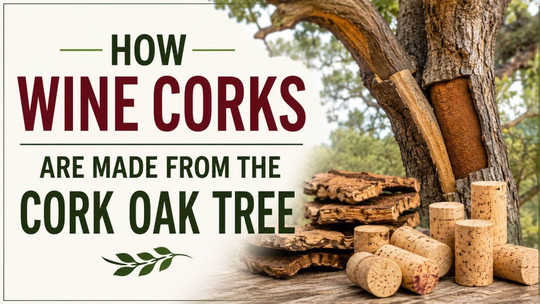
How Wine Corks Are Made from the Cork Oak Tree
Wine corks have been used to seal bottles for centuries, and for good reason. They create a tight seal while allowing tiny amounts of oxygen to enter the bottle, helping many wines age gracefully. What makes them even more remarkable is that they come from the bark of a single tree species—the cork oak (Quercus suber). Unlike most harvested tree products, cork can be collected without cutting down the tree, making it one of the world's most sustainable natural materials.
What Is a Cork Oak Tree?
The cork oak is an evergreen tree native to the western Mediterranean region, especially Portugal, Spain, Morocco, Algeria, Italy, France, and Tunisia. It thrives in warm climates with mild winters and can live for over 200 years.
These trees develop a thick, spongy outer bark that naturally protects them from drought, insects, disease, and even wildfires. This unique bark is what becomes the cork used in wine bottles and many other products.
Why Cork Is Special
Cork is unlike ordinary wood because it contains millions of tiny air-filled cells that make it:
- Lightweight
- Flexible
- Waterproof
- Compressible
- Fire-resistant
- Naturally renewable
- Excellent at sealing bottles
These qualities make cork ideal for preserving wine while also being useful in flooring, insulation, bulletin boards, fishing floats, shoe soles, and craft projects.
Harvesting the Cork Bark
One of the most fascinating aspects of cork production is that the tree is never cut down.
Step 1: Let the Tree Mature
A cork oak must grow for about 25 years before its bark can be harvested for the first time.
The first harvest produces rough, uneven cork known as virgin cork, which usually isn't suitable for wine stoppers.
Step 2: Carefully Remove the Bark
During the summer, experienced workers use specialized axes to carefully peel away the thick outer bark.
Only the outer bark is removed while the living layer beneath remains untouched. This allows the tree to continue growing normally.
Because harvesting requires skill and precision, it is almost entirely done by hand.
Step 3: Allow the Tree to Recover
After harvesting, the tree begins producing a fresh layer of cork bark.
It typically takes 9 to 12 years before enough new bark has grown for another harvest.
A healthy cork oak can be harvested 15 to 20 times during its lifetime.
Preparing the Cork
Once harvested, large sheets of bark go through several processing steps.
Drying
The bark is stacked outdoors for several months where it naturally dries and stabilizes.
Boiling
The cork is then boiled in clean water to:
- Remove impurities
- Kill insects and fungi
- Increase flexibility
- Flatten the bark
Resting
After boiling, the cork rests again so it can fully stabilize before being processed.
Making Wine Corks
When the cork sheets are ready, manufacturers begin cutting them into wine stoppers.
Punching the Corks
Machines punch perfectly round cylinders from the thickest sections of cork bark.
These natural corks become premium wine stoppers.
Finishing
Each cork is:
- Trimmed
- Sanded smooth
- Washed and sterilized
- Inspected for quality
Many corks are then coated with food-safe wax or silicone so they slide easily into bottles and can be removed smoothly with a corkscrew.
What Happens to the Leftover Cork?
Very little cork goes to waste.
Remaining pieces are ground into granules and used to make:
- Agglomerated cork stoppers
- Flooring
- Wall tiles
- Insulation
- Soundproofing panels
- Sports equipment
- Shoe products
Nearly every piece of harvested cork finds a purpose.
Environmental Benefits
Cork harvesting is considered one of the most environmentally friendly forestry industries.
Benefits include:
- Trees remain alive after harvesting.
- Cork oak forests absorb significant amounts of carbon dioxide.
- Harvesting encourages continued bark growth.
- Cork forests provide habitat for many rare birds and wildlife.
- Forests help prevent erosion and desertification.
Because the trees continue living for centuries, cork is a truly renewable resource.
Natural Cork vs. Synthetic Cork
Natural cork remains the preferred choice for many premium wines because it offers a traditional appearance and excellent aging characteristics.
Synthetic corks are made from plastic materials and eliminate the risk of cork taint, while screw caps have also become popular for many wines due to their consistent seal.
Each closure has advantages, but natural cork continues to be prized for high-quality wines.
Interesting Facts About Cork Oak Trees
- Portugal produces over half of the world's cork supply.
- Cork oak trees can live more than 200 years.
- A single tree may be harvested for nearly two centuries.
- The bark regenerates after every harvest.
- Cork contains millions of microscopic air cells, making it naturally buoyant.
- Every natural wine cork begins as the bark of a living tree.
Final Thoughts
The journey from cork oak tree to wine bottle is a remarkable example of sustainable forestry. Instead of cutting down trees, skilled harvesters carefully remove the bark, allowing the tree to regenerate and continue producing cork for generations. This renewable process has supplied wineries around the world for hundreds of years while protecting valuable forests and supporting local economies.
Whether you're opening a favorite bottle of wine or using cork in crafts and home projects, you're holding one of nature's most renewable and fascinating materials.