
Posted by TJ Hopkins on Jun 13th 2026
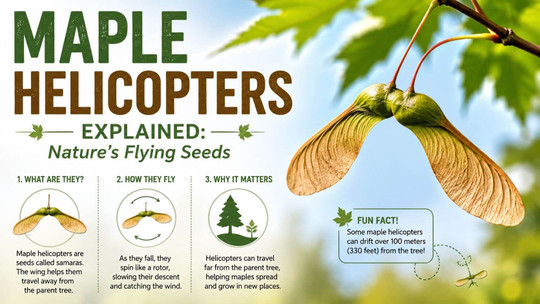
Maple Helicopters Explained: Nature’s Flying Seeds
If you’ve ever watched tiny spinning “helicopters” twirling through the air, you’ve witnessed one of nature’s most effective seed dispersal systems. These familiar flying seeds come from maple trees and are known as samaras. Their unique winged structure allows them to travel away from the parent tree, increasing the chances of successful germination and growth.
Maple helicopters are more than just a fun seasonal sight. They represent an ingenious natural adaptation that has helped maple trees spread across forests, parks, and landscapes throughout North America and beyond.
What Are Maple Helicopters?
Maple helicopters are winged seeds produced by maple trees. Botanically, these seeds are called samaras. Each samara contains a seed attached to a thin, papery wing that helps it glide and spin through the air.
Many maple species produce paired samaras that hang together on branches. As the seeds mature, they eventually separate from the tree and are carried away by gravity and wind.
How Do Maple Helicopters Fly?
The distinctive spinning motion of a maple helicopter is what makes it so effective. As the samara falls, the wing causes it to rotate rapidly. This spinning action creates lift and slows the seed's descent.
Because the seed falls more slowly, it remains airborne longer and can be carried farther by the wind. This increases the distance between the seed and the parent tree, reducing competition for sunlight, water, and nutrients.
Scientists have long studied maple samaras because their aerodynamic design is remarkably efficient. Their natural flight mechanics have even inspired research into small aircraft and drone technology.
Why Do Maple Trees Produce Helicopter Seeds?
The primary purpose of helicopter seeds is dispersal. Trees benefit when their offspring grow away from the parent tree rather than directly beneath it.
Spreading seeds over a wider area provides several advantages:
- Reduces competition among seedlings.
- Increases access to sunlight and soil resources.
- Helps trees colonize new areas.
- Improves species survival over time.
- Reduces the impact of pests and diseases concentrated around mature trees.
This strategy has contributed significantly to the success of maple species in a variety of environments.
Types of Maple Trees That Produce Samaras
Many maple species produce helicopter seeds, including:
- Sugar Maple (Acer saccharum)
- Red Maple (Acer rubrum)
- Silver Maple (Acer saccharinum)
- Norway Maple (Acer platanoides)
- Boxelder (Acer negundo)
While the size and shape of the samaras vary slightly between species, they all use the same basic spinning mechanism to disperse seeds.
How Far Can Maple Helicopters Travel?
The distance traveled depends on wind conditions, tree height, and the species of maple. Most samaras land relatively close to the parent tree, but strong winds can carry them surprisingly far.
In favorable conditions, some maple helicopter seeds have been observed traveling hundreds of feet from the parent tree. This ability allows maple populations to gradually expand into new habitats over time.
Can You Grow a Maple Tree From a Helicopter Seed?
Yes. Maple helicopter seeds contain viable embryos that can grow into new trees. However, many maple species require a period of cold moist stratification before germination.
To grow maple trees from seed:
- Collect mature samaras after they fall.
- Remove any damaged or empty seeds.
- Follow the specific stratification requirements for the maple species.
- Plant seeds in well-drained soil.
- Keep the soil consistently moist during germination.
With proper care and patience, a single samara can develop into a healthy maple tree.
Fun Facts About Maple Helicopters
- The proper botanical name for a helicopter seed is a samara.
- Maple trees can produce thousands of samaras in a single season.
- Children often use the seeds as natural toys because of their spinning flight.
- Different maple species produce different wing angles and seed sizes.
- The spinning action helps stabilize the seed during descent.
- Maple samaras are considered one of the most efficient natural seed dispersal mechanisms.
Conclusion
Maple helicopters are a fascinating example of nature’s engineering. These winged samaras use spinning flight to slow their descent, catch the wind, and travel away from the parent tree. By dispersing seeds over a wider area, maple trees improve their chances of survival and expansion. The next time you see a maple helicopter spinning toward the ground, you’ll know you’re watching an important part of the tree’s life cycle.