
Posted by TJ Hopkins on Jul 6th 2026
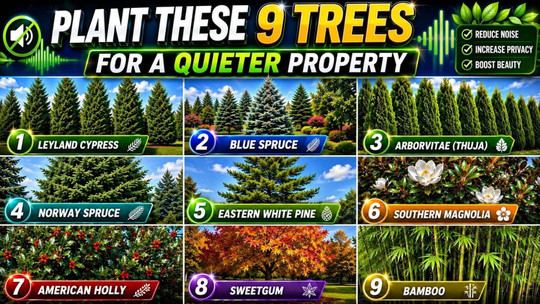
Plant These 9 Trees for a Quieter Property
If traffic, noisy neighbors, barking dogs, or nearby roads are disrupting your peace and quiet, strategically planting trees can make a noticeable difference. While trees won't completely soundproof your property, dense plantings can reduce noise levels by absorbing, reflecting, and scattering sound waves. A properly designed tree barrier can also improve privacy, block wind, and create a beautiful natural landscape.
Here are nine of the best trees for creating a quieter, more peaceful yard.
1. Leyland Cypress
The Leyland Cypress is one of the fastest-growing privacy trees available. Growing up to 3 to 5 feet per year under ideal conditions, it quickly forms a dense evergreen wall that helps soften traffic noise and provides year-round screening.
Why it's great for noise reduction:
- Extremely dense evergreen foliage
- Fast-growing privacy screen
- Blocks wind and road noise
- Excellent for large properties
Growing Conditions
- USDA Zones: 6–10
- Mature Height: 50–70 feet
- Sun: Full sun
- Soil: Well-drained
2. Blue Spruce
Blue Spruce offers thick branching from the ground up, making it highly effective at reducing sound while adding stunning blue-gray color to the landscape.
Its dense needles remain year-round, allowing it to provide consistent noise reduction in every season.
Growing Conditions
- USDA Zones: 2–7
- Mature Height: 50–75 feet
- Sun: Full sun
- Soil: Moist, well-drained
3. Arborvitae (Thuja)
Arborvitae has become one of America's favorite privacy trees for good reason. These narrow evergreens grow closely together, creating living walls that help absorb neighborhood noise.
Popular varieties like 'Green Giant' and 'Emerald Green' are excellent choices depending on available space.
Growing Conditions
- USDA Zones: 3–8
- Mature Height: 12–60 feet (variety dependent)
- Sun: Full sun to partial shade
- Soil: Moist, well-drained
4. Norway Spruce
Norway Spruce develops long sweeping branches covered with dense needles, creating one of the best natural sound barriers available.
It is especially useful for larger rural properties where traffic or highway noise is an issue.
Benefits
- Thick evergreen foliage
- Excellent windbreak
- Wildlife habitat
- Long-lived landscape tree
5. Eastern White Pine
Eastern White Pine is a soft-needled evergreen that grows rapidly into a towering screen. Although its branches appear airy individually, planting several together creates an impressive buffer against unwanted noise.
It is also one of the best native evergreen trees for wildlife.
Growing Conditions
- USDA Zones: 3–8
- Mature Height: 50–80 feet
- Sun: Full sun
- Growth Rate: Fast
6. Southern Magnolia
Southern Magnolia combines beauty with functionality. Its thick, glossy evergreen leaves remain on the tree year-round, helping dampen sound while producing some of the most spectacular flowers of any landscape tree.
The large canopy also creates welcome shade during summer months.
Growing Conditions
- USDA Zones: 7–10
- Mature Height: 60–80 feet
- Sun: Full sun
- Soil: Slightly acidic, well-drained
7. American Holly
American Holly is often overlooked as a noise-reducing tree, but its dense branching and evergreen foliage make it an excellent option for smaller privacy screens.
Bright red berries provide winter interest while attracting birds to your landscape.
Benefits
- Dense evergreen foliage
- Excellent privacy hedge
- Wildlife friendly
- Attractive year-round appearance
8. Sweetgum
Unlike evergreens, Sweetgum loses its leaves in winter, but during the growing season its dense canopy helps reduce noise while providing exceptional shade.
The brilliant fall colors—ranging from yellow and orange to deep crimson and purple—make it one of the most beautiful landscape trees.
Growing Conditions
- USDA Zones: 5–9
- Mature Height: 60–80 feet
- Sun: Full sun
- Soil: Moist, well-drained
9. Bamboo
Technically a giant grass rather than a tree, bamboo deserves a place on this list because of its incredible ability to form dense living walls.
Clumping bamboo varieties are generally recommended for residential landscapes since they stay contained and require less maintenance than running types.
Benefits
- Extremely fast-growing
- Dense sound barrier
- Tropical appearance
- Excellent privacy screen
How Trees Reduce Noise
Trees reduce sound in several ways:
- Dense foliage absorbs sound waves.
- Branches scatter and deflect noise.
- Thick trunks help block low-frequency sounds.
- Leaves create pleasant natural sounds that help mask unwanted noise.
- Multiple rows of trees are significantly more effective than a single row.
For the best results, plant trees in staggered rows rather than a straight line. Combining evergreens with shrubs creates a thicker barrier that performs better throughout the year.
Tips for Maximum Noise Reduction
To create the most effective natural sound barrier:
- Plant trees as close to the noise source as practical.
- Use two or three staggered rows instead of one.
- Mix evergreen trees with dense shrubs.
- Minimize gaps between plants.
- Choose fast-growing species if you need quicker results.
- Maintain healthy, full foliage with regular watering and pruning during establishment.
Final Thoughts
No tree can completely eliminate noise, but the right combination of dense evergreens and large canopy trees can make your yard significantly quieter while increasing privacy, improving wildlife habitat, and boosting curb appeal. Whether you choose fast-growing Leyland Cypress, dependable Arborvitae, majestic Norway Spruce, or elegant Southern Magnolia, these trees offer long-term benefits that make your outdoor space more peaceful and enjoyable for years to come.