
Posted by TJ Hopkins on Jul 14th 2026
What Happens If You Put Your Finger in a Venus Flytrap?
Venus flytraps are among the most fascinating plants in the world. Their jaw-like traps snap shut in a fraction of a second, allowing them to capture insects and other small prey. With rows of pointed “teeth” surrounding each trap, these unusual plants can look surprisingly intimidating.
But what would happen if you placed your finger inside a Venus flytrap? Would it hurt? Could the plant bite you or damage your skin?
The answer is much less frightening than you might expect. A Venus flytrap can close around your finger, but it cannot seriously hurt you. In fact, repeatedly triggering the trap is usually more harmful to the plant than it is to your finger.
How Does a Venus Flytrap Know When to Close?
Venus flytraps have tiny, sensitive hairs located on the inside surfaces of their traps. These are known as trigger hairs.
When an insect crawls inside a trap and touches a trigger hair, the plant does not always close immediately. Generally, the trigger hairs must be touched more than once within a short period. This helps the plant distinguish moving prey from falling raindrops, blowing debris, or other accidental contact.
Once the plant detects enough movement, the two sides of the trap quickly snap together.
The pointed structures around the edges interlock like the bars of a cage. These structures are often called teeth, but they are actually modified leaf parts known as marginal spines or cilia. They help prevent captured insects from escaping.
What Happens When You Put Your Finger in a Venus Flytrap?
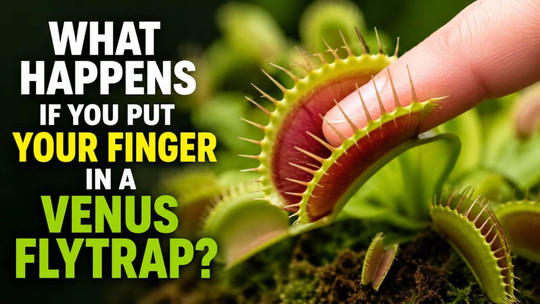
If you gently place your finger inside an open Venus flytrap and touch its trigger hairs, the trap may snap shut around your finger.
You will probably feel a light squeezing or brushing sensation. The trap may feel similar to a soft clip closing against your skin, but it does not have enough strength to cause significant pain.
A Venus flytrap cannot:
- Bite through your skin
- Draw blood
- Break a finger
- Inject venom
- Sting you
- Digest a living human finger
The trap may briefly close around your fingertip, but your finger is much too large for the plant to seal around it completely.
Does a Venus Flytrap Bite Hurt?
For most people, being caught by a Venus flytrap does not hurt at all.
The traps are designed to capture small insects such as flies, ants, beetles, spiders, and other tiny creatures. They do not produce enough force to injure a person.
You may feel a very gentle pinch if a larger trap closes around a small fingertip, but it should not cause an injury. Young children may be surprised by the quick movement, although the plant is not considered dangerous to touch.
The pointed structures around the trap can look sharp, but they are relatively soft and flexible. They are not comparable to animal teeth and are unlikely to puncture healthy skin.
Can a Venus Flytrap Digest Your Finger?
No. A Venus flytrap cannot digest your finger.
After capturing suitable prey, the plant seals the edges of its trap and releases digestive fluids. These fluids slowly break down the soft parts of an insect so the plant can absorb nutrients.
However, your finger is far too large for the trap to close and form a tight seal. Without a complete seal, the plant cannot create the enclosed digestive environment needed to process prey.
Even if digestive fluids came into contact with your skin, they would not dissolve your finger. Human skin provides a strong protective barrier, and the small amount of digestive fluid produced by the plant is intended for tiny insects.
Will the Venus Flytrap Let Go of Your Finger?
Yes. You can gently remove your finger without harming yourself.
Because the trap does not clamp down with much force, it cannot hold your finger in place. You should be able to slowly pull your finger away.
Avoid quickly yanking or twisting your finger because this could damage the plant’s delicate trap. The leaf may bend, tear, or become detached if handled roughly.
If the trap closes without catching suitable prey, it will usually reopen after it determines that there is no food inside. This may take several hours or a day or two, depending on the plant and its growing conditions.
Is Triggering a Venus Flytrap Bad for the Plant?
Triggering a trap once out of curiosity is unlikely to kill a healthy Venus flytrap. However, repeatedly making the traps close can weaken the plant.
Closing a trap requires energy. The plant must then use additional energy to reopen it. Every trap has a limited working lifespan and can generally open and close only a certain number of times before it stops functioning.
Repeatedly touching the trigger hairs without providing food wastes the plant’s energy. Over time, the trap may become slower, remain closed, turn black, or die.
The rest of the plant can remain healthy and continue producing new traps, but unnecessary handling may shorten the life of individual leaves.
Why Do Venus Flytraps Eat Insects?
Venus flytraps grow naturally in nutrient-poor, acidic soils. Their native habitat is found primarily in parts of North and South Carolina.
Because the soil contains limited amounts of certain nutrients, especially nitrogen, Venus flytraps developed the ability to capture and digest small animals.
The plant still receives energy from sunlight through photosynthesis. Insects do not replace sunlight. Instead, captured prey provides additional nutrients that support healthy growth.
This is why Venus flytraps still need plenty of bright light even when they occasionally catch insects.
What Happens After a Venus Flytrap Catches an Insect?
When a small insect becomes trapped, it usually continues moving and touching the trigger hairs. This repeated movement tells the plant that it has captured live prey.
The trap then closes more tightly and forms a seal. Digestive fluids are released inside, gradually breaking down the insect’s soft tissues.
Digestion may take several days. Once the process is complete, the trap reopens and reveals the remaining hard parts of the insect, such as its outer shell.
Wind or rain may remove the remains, allowing the trap to potentially capture another meal.
Can Venus Flytraps Hurt Pets?
Venus flytraps are not powerful enough to injure dogs, cats, or other household pets.
A trap might close around a pet’s whisker, paw hair, or nose if the animal investigates the plant, but it would not have enough strength to cause serious harm.
The plant is generally at greater risk because a curious pet may chew, crush, knock over, or pull apart its delicate traps.
Keeping the plant in a protected sunny location can help prevent accidental damage.
Should You Feed a Venus Flytrap With Your Finger?
No. A finger does not provide the movement, nutrients, or proper size needed for successful digestion.
Outdoor Venus flytraps can usually catch enough insects on their own. Indoor plants may occasionally benefit from a small live insect, but feeding is not always necessary when the plant receives adequate light and proper care.
Avoid feeding Venus flytraps:
- Human food
- Hamburger
- Cheese
- Candy
- Fruit
- Processed meat
- Large insects
Food that is too large may rot inside the trap and cause the leaf to turn black.
What Should You Do If You Accidentally Trigger a Trap?
If you accidentally touch a trigger hair and cause the trap to close, there is usually nothing you need to do.
Allow the trap to reopen naturally. Do not force it apart because pulling on the lobes can damage the leaf.
One accidental closing is unlikely to harm a healthy plant. The biggest concern is repeatedly triggering several traps for entertainment.
Are Venus Flytraps Safe to Grow at Home?
Yes. Venus flytraps are safe and fascinating plants to grow around the home.
Despite their dramatic appearance, they are harmless to people. Their traps are specialized for catching tiny prey and do not have the strength or size needed to injure humans.
For healthy growth, provide:
- Several hours of direct sunlight each day
- Nutrient-poor carnivorous plant soil
- Distilled water, rainwater, or reverse-osmosis water
- Consistently moist soil
- A winter dormancy period
Avoid ordinary tap water when it contains high levels of dissolved minerals. Mineral buildup can damage the plant over time.
Final Thoughts
Putting your finger in a Venus flytrap may cause the trap to snap shut, but it will not bite through your skin or seriously hurt you. At most, you may feel a light squeeze from the trap and its soft, interlocking edges.
Although the experience is harmless to people, repeatedly triggering the traps can waste the plant’s energy and shorten the lifespan of its leaves.
Venus flytraps may look like miniature monsters, but their traps are designed for insects—not human fingers. The best way to enjoy these fascinating carnivorous plants is to observe their natural behavior and avoid closing the traps unnecessarily.